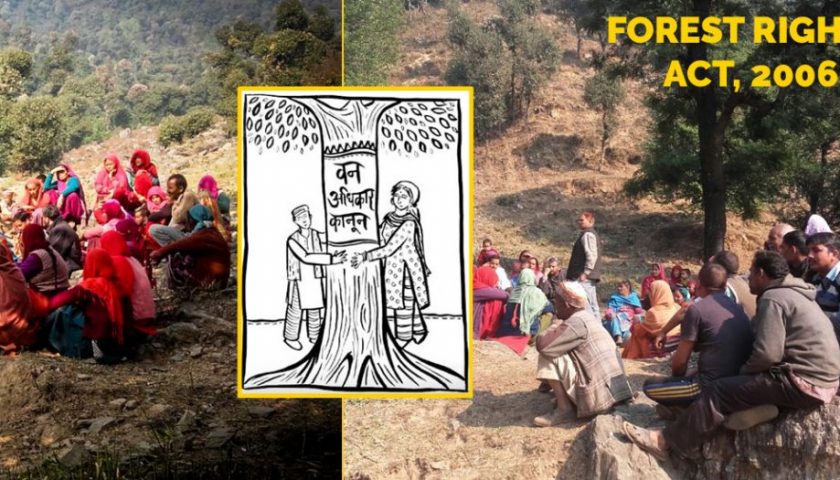
Forest Right Act and Problems Faced the Forest Dwellers of Our Country in Getting their Claim Recognized.
India has introduced several laws that give benefit to the sufferer and also leads the country towards development. The Scheduled Tribes and Other Traditional Forest Dwellers (Recognition of Forest Rights) Act, 2006 is the perfect example of this. Approximately, 250 million people reside around forests in India, out of which 100 million were estimated to be Adivasi or tribal population. The act came into force on 31 December 2007. This act is introduced to provide empowerment and rights to the forest dwelling communities from the colonial forest laws in India. The act is known with different names such as the Forest Rights Act, the Tribal Rights Act, the Tribal Bill, and the Tribal Land Act. This act is brought up to address the ‘Historical Injustice’ suffered forest dwellers.
Who is a Forest Dweller under the Act?
The one who “primarily reside in forests” and who depend on forests and forest land for a livelihood. Further, either the claimant must be a member of the Scheduled Tribes scheduled in that area or must have been residing in the forest for 75 years. (Source- Wikipedia)
Problems Faced The Forest Dwellers:
On February 13, 2019, The Supreme Court rejected the claims of lakhs of forest dwelling Scheduled Tribe (ST) members and Other Traditional Forest Dwellers (OTFD) reinstate their rights under the Act. As the act recognises forest dwellers with certain limitations and restrictions as per its definition mentioned above, around 1 million forest dwellers are at risk to get recognition under the Scheduled Tribes and Other Forest Dwellers (Recognition of Forest Rights) Act, 2006. They will lose their forest land if they failed to prove themselves as ‘Forest Dweller’ according to the act.
The Bench of Supreme Court includes Justices Arun Mishra, Naveen Sinha and Indira Banerjee, they direct the latest decision on this important issue, after the central government failed to do. Madhya Pradesh is the highly affected region because of this decision as it gets the highest rejections. Around 7,67,467 ST claims were rejected, 4,45,047 OTFD claims were rejected in 17 states, with 1,95,222 claims yet to be adjudicated in three states.
Claims rejected state wise in detail:
| Andhra Pradesh | 66,351 claims rejected |
| Karnataka |
35, 521 ST claims and 1,41,019 OTFD claims rejected |
| Kerala |
39,999 ST claims and 894 OTFD claims rejected |
| Tamil Nadu |
7148 ST claims and 1811 OTFD claims rejected |
| Telangana |
82,075 claims rejected |
| (Source – Thenewsminute.com) | |
The apex court passed the order stating the time limit up to July 27 to evict the tribal, who are claiming that they own the forest land and submit the final report.
Criticism:
Many forest rights activists and supporters have raised their voice towards the loopholes of the Act and told that some of the rejected clauses were important. Somehow, the Act excludes some of the tribal and non-tribal forest dwellers. The Campaign for Survival and Dignity described the final form of the law as “both a victory and a betrayal” in their official statement on the occasion.

In this life full of possibilities & expectations, I draw my imagination with words. A creative writer, who want to change the world with the help of words. Whether crafting a dream or drafting a story, my artistic apprehension will always result into the finest outcomes. A storyteller, poet, digital marketer, or else every single thing that demands content, I am the one whom you need.
“A writer is a soul, with no one’s body”